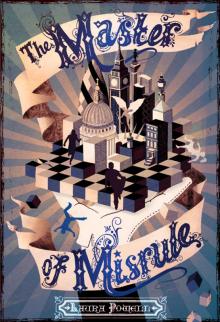
The master of misrule, p.6
The Master of Misrule, page 6


There was no other lead, so they shuffled along behind him. Even after the destruction they’d already witnessed, it was a shock to see the pictures on the wall. The centuries-old paintings of the triumphs had been slashed and spattered with red paint.
The doorkeeper surveyed their stunned faces. “It’s what you wanted, isn’t it?” he remarked, his voice heavy with contempt.
“No!” Toby protested. “Of course we didn’t. None of us ever imagined anything like this.”
“You wanted your prizes, though. You wanted to win at whatever cost.”
“The Game charges a high price,” said Flora quietly.
He turned to look at her. His face was shrunken and lined, with colorless, cloudy eyes. “So do all things worth having. Everyone who plays for a triumph does so by choice.”
“We’ve heard that argument before,” Cat said. “All those sermons about how the Game helps us change fate, find a fortune …”
“Yeah,” Blaine put in. “Funny how there’re never any speeches about the losers. It seems like even mentioning failure’s against your rules.”
“And it seems that you would rather live with no rules than with rules you dislike,” the man replied. “You would choose anarchy over authority.”
“Every time,” Blaine answered defiantly.
The doorkeeper let his broom fall with a clatter. “But you are not the only ones who must live with that choice. You had no right to make it.” Gently, he placed his hand on the torn canvas of Fortune’s Wheel, as if soothing a human hurt. “The man you set loose was imprisoned for a purpose. Misrule is anchored at the heart of the Game, but it must not be unleashed on it. You have seen the damage he has wreaked on my temple, and the Arcanum will fare no better.”
“There must be something we can do. To help reverse the damage to the Game, I mean,” Toby said.
“So this time you’re the Game’s champions? How noble spirited!” The doorkeeper snorted. “No, you have discovered that prizes won by crooked means are awarded crookedly also. And so your gamble has failed, and you wish to change your luck. That is why you came here, to pick over the ruin of my temple. For I know very well what you’re after.”
He leveled an accusing stare at each of them in turn.
He pointed to Flora. “The sleeping girl,” he pronounced. The finger moved to Blaine. “The man who made you bleed.” It swung round to Cat. “And the one who stole your family.” Last, he turned to Toby. “As for you … Hmm. You, perhaps, are a different case. Still, there are no desires that the Game hasn’t already uncovered, no needs that it hasn’t been asked to satisfy. And I have witnessed them all.”
“How come you know so much about us anyway?” Blaine asked grudgingly.
The old man looked offended. “It is the High Priest’s business to know about everyone who enters my temple,” he said, drawing himself up to his full height.
“No way! As in the High Priest? From the Greater Arcana cards?” Toby cut in.
The old man nodded curtly and continued. “I am the guardian of the Game’s most sacred ground, the celebrant of its rituals and the keeper of its thresholds. I have known every king and queen who has ruled the Game, every knight who has gambled on it and every knave who has served it. I have known every chancer, too, though I never thought I would—”
“Live to see the day when oiks like us managed to spoil everyone’s fun,” Blaine finished. “No wonder you’re peeved.” He broke into a cough, looking at the man through watering eyes. “The thing is, how do we know you’re telling us the truth? Any bunch of thugs could have got in here and trashed the place. And even if Mr. Misrule is responsible, I’m not sure that’s proof he’s any worse a Game Master than the others. Maybe nobody ever wins this Game of yours. Maybe it’s always going to be a con, whoever’s in charge.”
This time, the man spoke calmly. “The Game has its traps, and the Arcanum its deceits. That is the gamble. Yet the principle behind our gamble is that a prize won fairly does not fail. Until now, every knight who has been awarded a triumph has been granted his wish.
“As for our new master of revels … The Arcanum grows too small for him, and his gambling lust has spread beyond the thresholds’ bounds. I will show you Misrule’s work, and where his Lottery will lead. Perhaps then you will begin to understand the ruin you have caused.”
They followed the doorkeeper—or High Priest, as they were learning to think of him—to the stairs at the end of the hall, which led up to a pair of doors inlaid with a design of interlocking wheels in black and gold. Behind the doors was a mirrored ballroom that took up the entire second floor.
It seemed the marauders’ energy had flagged by the time they reached this final room, for the place was not as wrecked as the rest of the house. Most of the mirrors, although badly cracked, still lined the walls; the sparkle of light on their webs of shattered glass was oddly beautiful. Fists or weapons of some kind had left silvery starbursts at the point of impact, from which the fissures rippled outward like the rings after a stone is thrown into water.
For a few moments, the four chancers just stood, blinking. The disorientating effect of standing among so many mirrors was intensified by the fretwork of glimmering scars, in which things were both reflected and fragmented. The High Priest stood within the doorway, his hands clasped tight, murmuring nameless words under his breath and watching the chancers watch the walls.
Theirs were not the only images in the glass. As they looked, they began to see other figures moving across the gleaming surfaces, in a shifting reflection of scenes and people who were not there.
Gradually, they realized that they were watching the destruction of Temple House.
They saw a bearded man take an ax to the piano in the music room. A woman gleefully put her cigarette lighter to a silk wall hanging. A pack of youths rampaged through the bookshelves in the library. Another group hurled crystal champagne flutes down the stairs.
And in every splintered view, every jigsaw glimpse, there was a man with flowing white hair and hot blue eyes, whose face was neither old nor young, and whose smile was at one moment innocently bright and the next a crooked grin. There was no sound at first, but his head was thrown back in laughter as he urged the mob on.
Finally, the view of Temple House fractured and slid apart until there was only one image, everywhere. The Master of Misrule.
He had cast off the plain, dark clothes they had first seen him in for motley-colored robes, and he stood, arms outstretched, in the center of a wheel of blue fire. As the wheel spun and sparked, cards flew out from its axis and into the wind its whirling raised.
Before long the cascade of cards grew so frenzied it was as if the mirrors were filled with static. Yet when the fuzz and crackle cleared, the scenes revealed were remarkable only in their ordinariness. Pubs and offices, supermarkets and railway stations. There were cards there, too, though—glinting silvery blue on black, rich with possibility.… An allure that only grew stronger as people picked them up from pavements and doormats, or shook them out from magazines.
The chancers watched as a series of silver coins was scratched away and a sequence of laughing heads and forked tails was revealed. At first, the recipients responded with nothing stronger than a baffled smile or shrug. But soon their reactions grew more extreme. Winners punched the air in triumph. Losers recoiled, grew pale. Banner posters and billboards proclaimed:
And it was the image of the cards that flashed around the mirrors now: reproduced in newsprint, beamed through airwaves, projected onto screens.
A burning wheel towered over a city skyline. This was the chancers’ own London, free of the transformations and exaggerations of the Arcanum—except for that circle of azure flame. Beneath it, a crowd swelled. Every age, every profession, every kind of person was there. Some looked merely curious, but many bore the flush of desperation or greed.
The wheel spun to the sound of fairground jingles. Once again a wild wind blew, sending sparks and cards flying. These had no lettering or silver coins on them: their illustrations belonged to the Game of Triumphs deck. Nevertheless, the crowd surged to catch them, leaping and stumbling, trampling over each other in their lust to win.
The scene changed.
A gray morning. Quiet streets, tense faces.
The Day of the Lottery.
Let me be lucky.…
Be lucky, people murmured to themselves, whether fearful or excited or resigned, as they waited to receive their fate. Thick, gilt-trimmed cards that appeared out of nowhere to lie on doormats and desks, in handbags and briefcases, the folds of a newspaper or coat.
Many of the cards were blank except for a single line.
Others bore pictures that the chancers recognized: illustrations of violence and transformation, fantasy and horror. But these cards did not need to be taken into the Arcanum for the experiences they depicted to come true.
Justice. Two of Swords.
Six of Wands. Love.
Death.
Their images came thicker and faster in the mirrors. Sometimes they were the flat illustrations from the cards; sometimes it was like looking into the Arcanum itself. Soon the glass was a kaleidoscope of moving color: rainbows and starbursts and shivers of light, all breaking, sliding, slithering into one another.
Until the mirrors returned to Misrule and his wheel.
The sun shone cold and black in a crimson sky, and skeleton trees grew root-first from rocks that writhed and squirmed. A ruined city sprawled around. The river that ran through it did not flow with water, but with yellow sand. Snakes swam through the air, and birds dragged themselves across the ground with leaden wings.
Dead leaves twirled in the wind that whipped around the wheel and out of the mirrors, tangling the chancers’ hair and tugging at their clothes. The leaves blew around them also—except they were not leaves, but the charred remains of triumph cards.
The Master of Misrule looked straight into their eyes. This time, they could hear his laughter. The wheel’s blue flames burned cold as ice, and its reflection whirled on every side, so that they seemed locked in a prism of freezing fire. The light grew fiercer, whiter, spitting and hissing from each frosted shard of glass, until at last there was a mind-shattering crash as the mirrors fell to the floor, and the room plunged into darkness.
In the sudden silence, the four chancers could hear the laboring of their breath. The High Priest, meanwhile, was swaying with exhaustion. When he spoke again, they could see the effort it took to hold himself upright.
“Your city is the first to come under Misrule’s spell, but it will not be the last. Already, you have seen his calling cards appear on your streets. Soon he will enslave chance to his will, corrupting its powers so that it is no longer one force among the many in men’s lives, but the only one. Do you see, now, what you have done?”
All around them were scraps of burned cards and jagged heaps of glass. Cat’s face swam out at her from one of the bigger pieces.
“Nobody wants a load of flying snakes and skeleton trees,” Cat said, more aggressively than she felt. “But I don’t see how all that doomsday stuff can come out of a few scratchcards.”
“Then you should have paid more attention.” The old man scowled. “To play even one of those scratchcards is to disturb the natural balance of luck in the world. With every head or tail that is uncovered, the more power Misrule gains. When he is ready, he will launch his Lottery, and deal the first round of fates from his wheel.
“You know the cards in the triumph deck, and how one card’s lot has a thousand variations. At first, perhaps, the changes in fortune may be simple, and small. Some players might uncover a secret. Others might go on a journey or meet a stranger. Many will find new hope. Still more, sudden loss. As you saw, a number of cards will be blank. But whoever is dealt a new fate shall not escape it.
“For as Misrule’s Lottery increases its grip, the nature of the cards will change. They will take on the Game’s powers to summon angels and demons, resurrect the dead, create new gods. They shall burn towers and drown cities. Men will walk through their own pasts and see their most monstrous dreams made flesh.
“Human life is already erratic and perilous, threatened by crisis on every side. How many rounds of the Lottery will be played, how many different destinies will each man endure, before your civilization becomes as broken as my temple and as anarchic as the Arcanum? It will not be long, I think, before ruin takes hold.”
There was a shaky silence.
Flora raised her bowed head. “Very well,” she said quietly. “Tell us what we have to do.”
The High Priest seemed to have aged since they had entered the ballroom, for his face was more heavily lined, with an unhealthy green tint. “Tomorrow I will deal you a new round of cards,” he said, “and we will see what hope is left in the Arcanum. But tonight … tonight my strength is done. I want you gone from my temple.”
“Can’t we first—”
His eyes flashed. “What, you think it is an easy thing, to conjure visions in the scrying-glass? I summoned ghosts and demons for you, the image of Misrule himself! It was too much for the mirrors and nearly too much for me. No, I want you gone. Leave me, leave this place.”
“But we’ll come back tomorrow,” Toby insisted. “Us four will come back, OK, and you’ll show us what to do?”
“Regrettably, there is no other choice,” the Priest replied sourly as he picked up his broom.
USUALLY, WHEN THE CHANCERS left Temple House or a move within the Arcanum, they found that little time had passed on the other side of the threshold. But although it seemed like they couldn’t have been in the house for more than an hour, they stepped out to discover that night was drawing in.
The four of them stood on the pavement in a disconsolate huddle.
“The King of Swords warned me that the Hanged Man’s card used to be called the Traitor,” Cat said at last. “At the time, I just thought he was trying to pull a fast one on me. D’you think we can believe what we saw of Misrule? Can we trust the Priest?”
Flora roused herself a little. “Unfortunately, it seems to fit with what we already know, and I don’t just mean the scratchcards. When I was … was in Grace’s move, they—the Spinners, that is—said we’d done a great wrong. They accused me of making the Game ‘crooked.’ ”
“Exactly,” said Toby solemnly. “And Mia herself showed me what a mess the Arcanum was in.”
“It’s not the Arcanum’s welfare we have to worry about,” Blaine said grimly. He coughed, and the noise echoed hollowly round the square.
Flora winced. “God, you sound awful.”
“Sounds worse than it is. I think it’s the damp.”
“You’re still staying in that basement place, aren’t you?” Cat asked.
“The squat, you mean,” Toby muttered.
Blaine shrugged.
“Well, no wonder you’re ill,” said Flora. She looked better than she had earlier: the dull, fixed look had gone from her eyes. Flora was beginning to accept that, perhaps, the disaster of the Eight of Swords had not been her fault. On one level, she recognized that the stakes they were now playing for were so high that all other concerns were meaningless. Yet as long as Flora could still play the Game, she reasoned, Grace still had a chance.
She smoothed down her hair. “I think you should come home with me,” she announced.
“What?”
“I think you should stay with me until you’re better. My parents went abroad this morning and I’ve got the house to myself. There’s heaps of room.”
Blaine half laughed. “I’m sure there is. Very kind of you and all that, but I’m fine where I am. I know how to look after myself.”
“I’m not offering out of charity,” Flora said stiffly. “I don’t know exactly what we’ve got ourselves into, but however this crisis develops, we’re going to have to go back into the Arcanum to deal with it. In which case, each of us needs to be as strong and resilient as we possibly can. And, frankly, if you’re camping out in some squalid underground hole, you’re going to get worse, not better, and won’t be good for anything.”
“She’s right,” Cat said, though she sounded reluctant about it.
Blaine didn’t say anything at first. A chill wind sent cigarette butts and newspapers scuffling down the pavement, and he stooped over in another coughing fit. Finally, he straightened up and looked at Flora. “OK, fine. Whatever. I’ll crash at yours.”
In the brief time it took for Blaine to get his belongings from the squat, Flora had plenty of opportunity for second thoughts. They had said goodbye to the other two soon after leaving Mercury Square, and Flora agreed to wait for him at the top of Langdon Street. She disliked Soho at the best of times, and tonight its boozy garishness scraped at every frayed nerve. At the end of the road, a bus was pulling up to its stop. The advertising banner between the upper and lower decks was a swirl of silver, black and glitzy blue, and proclaimed:
Flora bit her lip. How had everything got so hideously out of control? Her invitation to Blaine already seemed nonsensical. She and Blaine had never had anything to say to each other. In ordinary circumstances they would never have anything to do with each other. This was also true of her and Cat and, to a lesser extent, Toby, too, but the hostility between her and Blaine had been mutual and instinctive from the start. Of course, after everything they’d been through in the Arcanum—where, arguably, she owed him her life—their antagonism had been left behind. In some ways Blaine knew her better than Georgia or Tilly or Charlie ever could. They were partners of a sort, she supposed, but that didn’t make them friends.
It’s going to be a disaster, she thought. And what on earth will I tell Mina?
Mina, the Seatons’ housekeeper, was meant to be keeping an eye on Flora over the rest of the holiday. Her parents had left to catch their flight early that morning but she hadn’t got up to see them go. She hadn’t seen them the evening before, either. After she had dragged her battered and frozen body back from the Eight of Swords, she had managed to shut herself in her bedroom before they returned from the Avoncourts’. Flora got migraines occasionally, so her parents knew from experience to leave her alone in a darkened room. They had exchanged commiserations through the door, and left her to it.