Frame, p.1
Frame, page 1
part #1 of Manhunt Mystery Classics Series
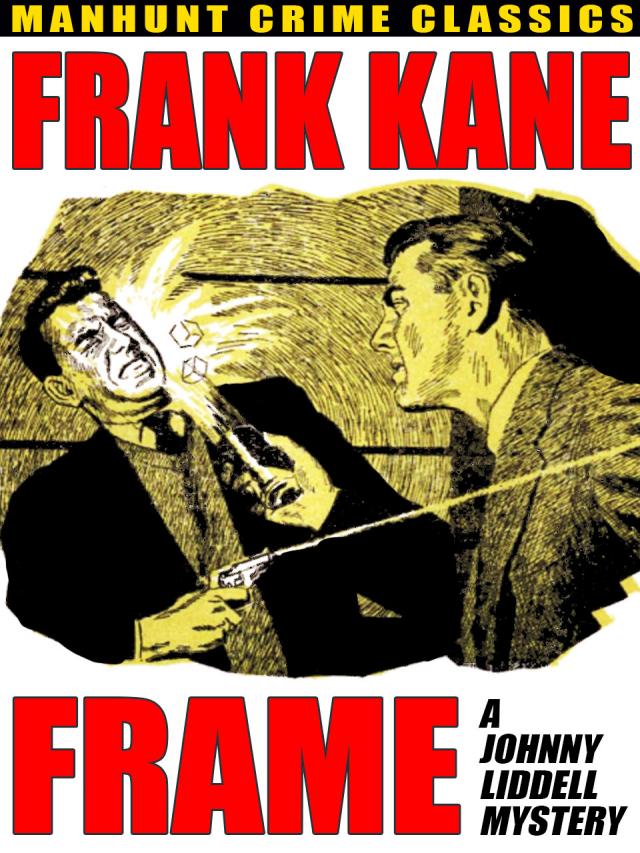


Table of Contents
FRAME
COPYRIGHT INFORMATION
INTRODUCTION
CHAPTER 1
CHAPTER 2
CHAPTER 3
CHAPTER 4
CHAPTER 5
CHAPTER 6
CHAPTER 7
CHAPTER 8
FRAME
A Johnny Liddell novelette
FRANK KANE
COPYRIGHT INFORMATION
Copyright © 2021 by Wildside Press LLC.
Originally published in Manhunt, August 1954.
Published by Wildside Press LLC.
wildsidepress.com | bcmystery.com
INTRODUCTION
Manhunt was a crime fiction magazine published between January 1953 and April-May 1967. Most issues were digest-sized, though collectors prize the few larger-format issues in 1957-58, which are generally harder to find. It was originally titled Manhunt Detective Story Monthly, but that was soon shortened to simply Manhunt, the name with which mystery readers are most familiar today. It ran for a total of 114 issues.
It was harder-edged than its competitors Ellery Queen’s Mystery Magazine Alfred Hitchcock’s Mystery Magazine, dealing more with noir, hardboiled, and crime tales than tranditional mysteries. Its closest competitor was probably Mike Shayne Mystery Magazine, though MSMM generally featured lower-quality work. If you look at the names published in all four magazines, you will find a lot of overlap. But the edgier writers always went to Manhunt first: names like Cornell Woorich, Frank Kane, Mickey Spillane, Richard S. Prather, Evan Hunter, and so many more could be found in its pages, alongside newer writers like Richard Deming, Fletcher Flora, Talmage Powell, and Lawrence Block—all of whom would go onto make names for themselves in later years.
* * * *
Which brings us to Frank Kane (1912-1968). Kane was brought up in Brooklyn, New York. He attended St. John’s Law School, but had to leave before graduation to support his spouse and newborn child. He found work as a columnist for The New York Press, as a letterer for the New York Trade Newspapers Corporation, for the New York Journal of Commerce, and in public relations, particularly as an advocate for the liquor industry. After World War II, he was a freelance writer, and his punchy, quick-paced scripts earned him writing jobs with such crime shows as The Shadow; Gang Busters; Counter Spy; The Fat Man; Casey, Crime Photographer; Mr. Keen, Tracer of Lost Persons; The Lawless Twenties; Nick Carter, Master Detective, and others. He created Call the Police for Lever Brothers and Claim Agent for NBC.
He also wrote fiction, publishing nearly 40 novels from the 1940s through the 1960s (most featuring his series character, hardboiled detective Johnny Liddell). He also wrote numerous short stories for crime magazines such as Manhunt, The Saint Detective Magazine, Private Eye, and Pursuit.
—John Betancourt
Cabin John, Maryland
CHAPTER 1
The phone on the night table started to ring shrilly, discordantly. Johnny Liddell groaned, cursed softly, dug his head into the pillow, but the noise refused to go away. He opened one eye experimentally, peered at the half lowered shade and noted that it was still dark.
He tried to wipe the sleep from his eyes, but it wouldn’t wipe away. The phone kept ringing. Finally, he reached out and lifted the receiver off its hook.
“Yeah?” he growled sleepily.
“This is Laury Lane. Come out here right away. That man of yours is going crazy and—” The voice was drowned out by the flat, ugly bark of a shot. The line went dead.
Liddell was suddenly wide awake. And ice cold. He started to jiggle the cross bar on the phone. “Hello. Hello.” The only answer was the soft click of a phone being hung up at the other end.
Liddell continued to jiggle the cross bar. The metallic voice of the operator cut in: “What number are you calling?”
“I’m not calling a number. Somebody was calling me. We’ve been cut off. Can you get them back?”
“I must have the number.”
Liddell growled deep in his chest. “Never mind, thanks. They’ll probably call back.” He tossed the receiver back on its hook, started stuffing his legs into his trousers. He headed for the bathroom, completed the waking-up process by splashing ice cold water into his face, then finished dressing. He shrugged into a shoulder harness, clipped his .45 into place, covering it with a jacket. He was headed for his garage less than ten minutes after the phone had started to ring.
CHAPTER 2
Laury Lane lived in a small colony of two-acre plot estates just outside of Sands Point on Long Island’s North Shore. Johnny Liddell headed out Northern Boulevard, making the forty-minute ride in something short of a half hour.
The house itself was set back from the highway and shielded from the road by a row of evergreens. Liddell swung through the stone pillars that supported a rarely-closed iron gate, followed the short winding driveway to the house. There were two other cars parked in front of the garage, on the concrete apron. Liddell left his in front of the house, walked up the two steps to the door.
There were no lights in the hall, but he could see a triangle of yellow light toward the back of the house were it spilled from an open door. He debated the advisibility of walking around back, decided to knock.
Almost immediately the door opened and he could make out the bulky figure of a man silhouetted in the opening.
“I’m Johnny Liddell. I want to see Miss Lane.”
The door opened wider. “Come on in.” The man stepped aside, waited until Liddell had entered, fell in behind him. “Straight ahead to the study.”
Liddell followed the darkened hallway to the open door. He stopped at the entrance to the room and looked around. Two men looked at him incuriously. One of them, a tall man in a rumpled blue suit and a battered fedora, grunted, “Who’s this, Allen?”
“Name’s Liddell. Says he wants to see Miss Lane.”
“Be my guest,” the man in the rumpled suit grunted. He walked over to where a blanket was draped over a suggestively shaped bulge, pulled it back.
Laury Lane lay on her back, her arm crooked languidly over her head. Her thick blonde hair was a tangle on the thick pile of the rug. Her green eyes were half closed. Her lips, full and inviting, seemed set in a half smile. A hole midway between her full breasts had spilled an ugly red stain on the white silk of her evening gown.
The man in the blue suit watched the scowl ridge Liddell’s forehead. He dropped the blanket back over the girl’s face. “You say you’re Liddell?”
The private detective nodded, dug into his pocket, brought out a pack of cigarettes and held it up for approval. When the lieutenant nodded, he stuck one in the corner of his mouth where it waggled. “I’m Liddell. Who’re you?”
The man in the blue suit pinched at his nostrils with thumb and forefinger. “Murray. Lieutenant in homicide out here. Mind telling me what brings you out this way at this hour?”
“Lane was a client. She wanted to see me.”
Murray pursed his lips, considered it. He tugged a dog-eared memo book from his hip pocket, jotted down some notes. “So you just drop by at—” He pushed up his sleeve, consulted his wrist watch—“at two o’clock in the morning?” His eyes rolled up from the notebook to Liddell’s face. “Keep kind of late office hours, don’t you?”
“Something had happened. She called me to get right out here. Something she wanted to talk to me about.”
The homicide man wet the point of his pencil on the tip of his tongue. “What was it that couldn’t wait?”
Liddell shrugged. “She didn’t say.”
“Maybe we can tell you,” Murray grunted. He led the way to the french doors that opened onto the back patio. “Put some light out here, Al,” he snapped at one of the other men.
Liddell followed him, stared down at the body of a man, sprawled face down on the patio. He knelt beside the body, lifted the hat off its face, swore under his breath.
“Know him?” Murray wanted to know.
Liddell nodded grimly. “One of my boys. Name’s Tate Morrow.”
“Have you any idea what he was doing out here, or is it customary with your organization to make late calls on clients?”
“Tate was assigned to Lane. He was bodyguarding her.” He straightened up, brushed the folds out of his knees. “Any idea of what happened?”
Murray grinned humorlessly. “We thought you might have some idea. Busting out here this way.”
Liddell shook his head. “No ideas.” He took a deep drag on his cigarette, wrinkled his nose in distaste, dropped the cigarette to the patio floor, ground it out. “Could be that Tate heard the shot that got the blonde, came running, and—”
The homicide man snorted. “Why don’t you start levelling? You can see he was headed away from her, not toward her.” He jabbed his hand into his jacket pocket, brought up a small gun, wrapped in a handkerchief. “This was lying right next to her hand. It’s got one bullet fired.” His eyes were bleak, unfriendly. “My guess is that the one in his back will match it.”
“That’s crazy and you know it. Why should Lane shoot the guy who was protecting her? And if she did, who shot her?”
“He did,” Murray snapped. “Show him, Al.”
The other detective walked over, spilled the contents of an envelope into the palm of his hand, held them toward Liddell. “Diamonds. We found them right near his hand, where he dropped them when he fell.” Murray turned his back, walked into the den. “That’s the way we see it,” he said flatly.
“That’s the way you’re supposed to see it. It’s a set-up, can’t you see?” Liddell argued. “You think that babe could get a gun, aim it and bring him down with one shot when she’s wearing a .45 slug for a lavaliere?” He caught the homicide man by the arm, swung him around. “That babe was deader than Kelsey the minute that slug tagged her. And my guess is that Tate was dead before that.”
Murray caught the private detective’s hand, lifted it from his arm. “Why should anybody go to all that trouble?”
“The diamonds,” Liddell snapped.
“And then leave without them?” Murray shook his head. “You’re not making sense.”
“You’re making less. You don’t think that handful of little stones is what Tate was guarding, do you? Lane had over $150,000 worth of unset stones. Where are they?”
The homicide lieutenant looked thoughtful, plucked at his lower lip. “That’s the first I hear of this. Fill me in.”
Liddell found another cigarette, lit it. “Lane was getting ready to retire. Did you know that?”
Murray shook his head, nodded for one of his men to answer a ring at the front door. “I don’t know much about the theatrical crowd. All I know I read in the columns. I thought she was a big star?”
Liddell shrugged. “She’s had her day. But she’s been fading fast for the past couple of years. This year she decided to go back home. She was British, you know.”
“Excuse me.” Murray went over to the door to shake hands with a small man carrying a brown instrument case. They carried on a whispered conversation for a few minutes; then the newcomer went over and pulled the blanket back from the dead woman. Murray walked over to where Liddell was standing. “The medical examiner,” he explained. “So she was going back to Britain. So?”
“She was turning everything she had into cash.” Liddell took the cigarette from between his lips, scowled at the glowing end. “For years she’s been collecting diamonds. They’re easier to hide, and the Treasury boys can’t put them onto an adding machine like they can the contents of a safe deposit box.” He took a last drag on the cigarette, stubbed it out in an ash tray. “She hired us to keep an eye on her until she turned the stones into cash.”
Two men from the M.E.’s office brought in a stretcher. Liddell broke off and watched glumly as they transferred the blonde to the stretcher, strapped her on.
“Whoever killed her knew about the stones. So he tried to make it look as though Tate did the job.”
“Could be,” Murray agreed.
“You’ve got other ideas?” Liddell wanted to know.
The homicide man shrugged. “Just ideas, so far. No proof.” He reached over, picked a thread off Liddell’s jacket and let it float to the ground. “Suppose your boy here did stop one, but his confederate managed to get away with the bulk of it?” He looked Liddell in the eye. “Who knew about the diamonds?”
Liddell scowled. Hard lines joined his nostrils with the end of his mouth, hard lumps formed on his jaw as he clenched his teeth. “Mike Murphy, Lane’s personal manager, for one. It was his idea to hire the agency because the stuff wasn’t insured.”
“Who else?”
Liddell studied the homicide man’s face carefully. “Louis Arms. He was supposed to be the buyer.”
“Arms, eh?” Murray raised his eyebrows, pursed his lips. “Anybody else?”
Liddell shrugged angrily. “Not that I know of. Not unless they spread it around.”
“Think they were likely to?” Murray sneered.
“No.”
The homicide man nodded. “Then that leaves just you and your boy, Liddell.” He jabbed his pencil at the private detective. “But you can undoubtedly tell us where you were all evening?”
“In bed.”
“Witnesses?”
“This happened to be my off night. I was in bed alone.”
Murray squinted, plucked at his lower lip. “But you got a phone call from the Lane girl and she told you to get right out here?”
Liddell nodded. “That’s right.”
The homicide man walked over to the desk in the corner of the room, lifted the telephone from its cradle. “We don’t have dials out here yet, you know. Pretty small time stuff to a big operator like you, I guess.” He turned his attention to the phone. “Millie? Ed Murray from Homicide. Say, about an hour ago, do you remember a call Laury Lane made to New York? Number was—” He raised his eyebrows at Liddell.
“Homeyer 5-7236,” Liddell grunted.
“Number was Homeyer 5-7236.” He waited a moment, then pursed his lips, looked at Liddell from under lowered lids. “You’re sure of that?” He nodded, dropped the receiver on its hook. “There haven’t been any calls from this number to a New York number tonight.”
“Maybe I got the message by ouija board,” Liddell growled.
“Maybe you didn’t get the message.”
“Let me get this straight, Murray. You’re trying to say that I didn’t get a call from Lane, that I came out here to meet Tate and cut up the dame’s diamonds. Then what happened to them?”
Murray grinned bleakly. “Maybe this isn’t the first time you came out tonight. Maybe you got here right after the shooting, picked up as much of the loot as you could find in the dark, hit back to town, stashed it and then came back to put on this injured innocence act.”
“That’s how it is, eh?”
Murray nodded. “That’s how it is. What are you going to do about it?”
“You mean I’ve got a choice? I’m going to find the real killer and hand him to you on a silver platter. You don’t have to worry, though, I’ll label him for you so you’ll know him when you fall over him.”
“And if I decide to take you in and book you?”
“On what? There’s not a judge in the county would hold me on your pipe dream. It’s like you said, you haven’t got a thing but an idea—a screwy idea. I’ll be around if you want to talk to me.”
CHAPTER 3
Mike Murphy lived in the Livermore Arms, an expensive pile of mortar and plate glass overlooking the East River at Beekman Place. Johnny Liddell parked his car out front, plowed across the deep pile rug in the ornate lobby to the desk. A white-haired man in an oxford grey suit with a wing collar made a half-hearted attempt to wipe the boredom out of his eyes as Liddell approached, but didn’t quite make it. His teeth were too shiny and too even to be real and Liddell had a passing suspicion about the color in his cheeks.
“Can I help you?” His fingers toyed with the triangle of white linen that peeped from his breast pocket.
“Will you ring Mike Murphy’s apartment? Tell him Johnny Liddell must see him immediately.”
“Certainly, sir.” The white-haired man sat down at a small switch-board, plugged in one of the wires. He licked at his lips before he spoke into the mouthpiece, nodded, then pulled the plug from the board. “It’s rather late, but he says he’ll see you.” He smoothed the hair over his ears with the flat of his hand. “It’s the penthouse.”
Liddell nodded, headed for a bank of elevators in the rear of the lobby. He jabbed the button marked Penthouse, chafed at the slow progress the cage made upward. The elevator glided to a smooth stop; the doors slid noiselessly open. Liddell crossed the small hall, pushed the buzzer set at the side of the door three times. There was the stuttering of a latch and the door swung open.
Mike Murphy stood in the middle of the room, a glass in his hand. He was tall, his broad tapering shoulders seeming to balance precariously on the slimness of his waist and hips. He wore his thick, black hair long on the sides, plastered back against his head. On top it was a mass of curls. His mouth was smeared with lipstick; his eyes were slightly off focus. He waved Liddell in.
“Come in, come in.” He called over his shoulder. “You can come on out, honey. It’s a friend.”
The door to an inner room opened and a long-legged redhead walked out. Her hair had been loosened and fell over her shoulders in a molten cascade. She had on a blue gown that gave ample evidence she wore nothing under it. As she walked, her breasts traced wavering patterns on the shiny silk of the gown. Her eyes were slanted, green. She looked Liddell over, seemed to like what she saw.
“This is Claire Readon, Liddell. Meet a real live private eye, baby.”
“You should have come earlier. The party was fun.” Her voice was sultry, disturbing.