Small animals caught in.., p.1
Small Animals Caught in Traps, page 1


Subscribe to our newsletter for title recommendations, giveaways and discounts reserved only for subscribers.
Join here.
Praise for
Small Animals Caught in Traps
“An absolutely gorgeous book . . .
Yes, it’s a story about loss, but at its rare beating heart,
it’s about what really matters: love. And I loved this book.”
—Caroline Leavitt,
New York Times bestselling author of With or Without You
“Bernard paints a haunting picture of an American West
where wildness is the last commodity . . . Small Animals
Caught in Traps is a heartbreaker of a domestic novel.
In any case, I won’t forget it.”
—Justin Tussing,
Oregon Book Award–winning author of
The Best People in the World
“As powerful as a sudden summer storm,
Small Animals Caught in Traps sweeps you up with rich,
heartbreaking details . . . With a gritty roster of characters
and an unforgettable sense of place, this is a book to savor.”
—Liz Michalski,
author of Evenfall and Darling Girl
“[Small Animals Caught in Traps] gives you love and heartache, disappointment and joy in equal measure . . . A wonderful read to go along with coffee or whiskey, or whiskey in coffee.”
—Pedro Hoffmeister,
author of American Afterlife
“Draws you in and holds you tight through an emotional and educational journey across the wilderness of the wild soul.”
—Tim Tigner,
bestselling author of The Price of Time
Books by C. B. Bernard
Small Animals Caught in Traps
Chasing Alaska: A Portrait of the Last Frontier Then and Now
Copyright © 2023 by Chris Bernard
E-book published in 2023 by Blackstone Publishing
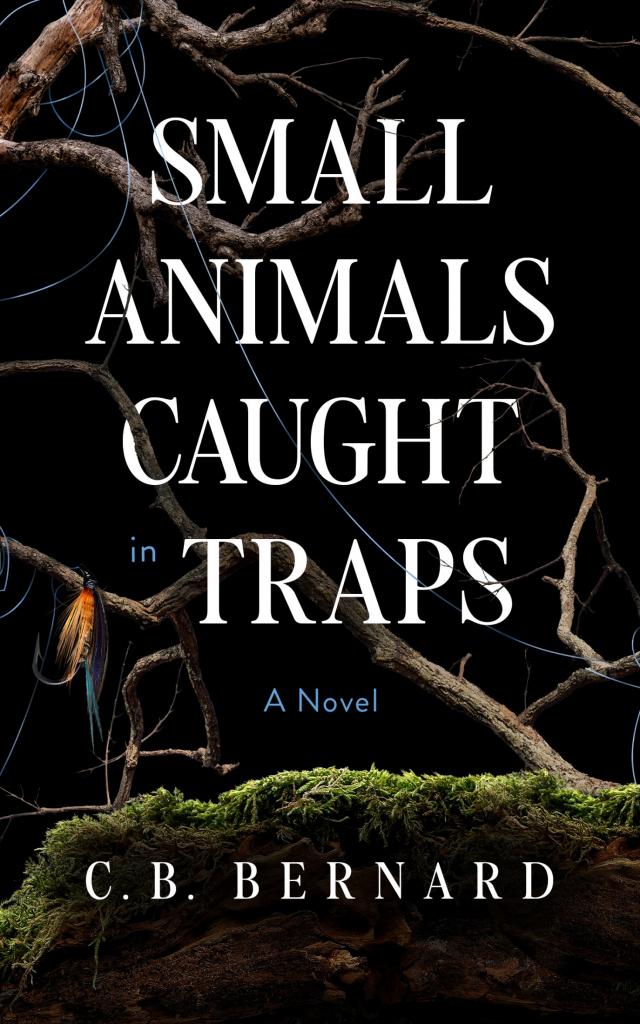
Cover design by Larissa Ezell
All rights reserved. This book or any portion thereof may not be reproduced
or used in any manner whatsoever without the express written permission of the
publisher except for the use of brief quotations in a book review.
The characters and events in this book are fictitious.
Any similarity to real persons, living or dead, is coincidental
and not intended by the author.
Trade e-book ISBN 979-8-200-79888-9
Library e-book ISBN 979-8-200-79887-2
Fiction / Literary
Blackstone Publishing
31 Mistletoe Rd.
Ashland, OR 97520
www.BlackstonePublishing.com
For my parents.
And for their parents.
“Are you happy now?”
—Richard Shindell
“Hell no, I ain’t happy.”
—Drive-By Truckers
I
DISAPPOINTMENT, OREGON
1
Lewis remembered trying to hide his fear from his father as he approached the animal, though it bared its teeth and hissed, arching its back and scraping the ground with long claws. The trap had torn its leg half off and left its fur spattered with blood. He remembered, too, how it studied him with black eyes, frantic with thirst, with hunger, with the terror that had possessed it since the steel jaw bit down on its hindquarter.
When it lunged, he’d flinched, stumbling backward and falling in the dirt at The Old Man’s feet. But the trap was chained to a stake. The animal could not reach him.
“What is it?” he asked.
His father spit on the ground beside him and lit a cigarette. “Mink.”
Foam gathered around the animal’s mouth as it thrashed the chain, trying to get at them. They’d set the trap near a trout stream last weekend and had returned to check it. Lewis wished he had not run ahead of his father on the trail. The mink had seen him first, which made him responsible for its suffering, or at least complicit.
“We have to help it,” he said. In response, his father smacked him with the back of his hand hard enough to darken his vision.
“The hell we do. What the hell you think we set the trap for in the first place?” The Old Man spit again. He was forever spitting, wads of phlegm yellowed with nicotine and whatever it was inside him that so bittered his world.
The chain rattled as the mink threw itself at the brush, no longer trying to attack but trying to flee. Their arrival had worsened its fear. With each lunge, the steel teeth bit deeper into its leg, peeling back fur and exposing flesh and then bone. They watched it turn on itself in a fury, chewing at its trapped leg until blood covered its face and ears too.
“Look what it will do to itself.” His father sounded amused. “That’s how bad it wants to escape. Shit.” He drew the word out into an appreciative sigh. “Even if it gets away there won’t be nothing of it left.”
As if it had understood, the mink stopped fighting and lay flat on its side. Matted with dirt and leaves, its filthy coat rose and fell with each diminished breath. Lewis knew the collective nouns for most animals—a muster of peacocks, a sleuth of bears; terms of venery, they were called—but he couldn’t remember the name for a group of mink. There wasn’t one. They’re solitary animals.
“We have to let it go,” he said again. He knew it might draw him another fist, but his father just looked at him.
“Don’t be that guy.” It was something The Old Man said all the time, pointing at a car that cut them off in traffic, a man holding his wife’s purse in the grocery store, a street-corner beggar in tattered clothes. He took a drag from his cigarette, exhaling through narrowed lips and nostrils. Squinting through the smoke, he shook his head slowly and flicked the cigarette butt at the boy’s chest. It exploded against the fabric of his shirt in a flurry of sparks.
Leaning his fly rod against a maple red with autumn, he took off his vest. The vest had more pockets than Lewis could count, a fleece patch where the heart should be decorated with brightly colored trout flies. The hooks flashed in the sun like the medals of an army general. He turned the vest inside out, wrapped it around his hand, and approached the mink. Its visible eye communicated something—fear, maybe, or recognition—but the mink had worn itself out, too tired to move. The chain stretched taut to the stake behind it, making a straight line, an arrow pointing deep into the woods. An arrow pointing to freedom. The Old Man squatted close and reached down slowly with the vest, grabbing the mink behind the head with one quick movement and lifting it in front of him, taking the tension from the chain.
“Coat’s still decent.” He turned the lithe body around to study it. “Even with the leg, it’s worth something.”
“Are you going to let it go?”
The Old Man looked at Lewis as if he were a trap closed around his leg. When he put his other hand on the mink, it was almost the length of the animal. Lewis hoped he would have hands that big someday. Tracing a line up the mink’s belly to its small chest, his father felt around, dug two long fingers into the fur, and squeezed. The mink went limp in his hand.
“If you pinch the heart, you kill it without leaving any marks. My own father taught me that, just like his father taught him. Now I’m teaching you.”
The chain rattled as he dropped the dead animal onto the ground.
“Maybe someday you’ll teach your own son too,” he said, though his expression made clear that he didn’t see any more reason to hope for such a thing than he did to hope for anything at all.
Remembering that day and remembering The Old Man as he watches the obstetrician at the foot of his wife’s hospital bed, Lewis wonders if there’s anything crueler than hope. The doctor has thin wrists, slender fingers, hands you wouldn’t trust to hold your drink, but he’s delivered most of the babies born in the county over the last half century and claims to have only dropped a few.
“Strike one,” he says, affecting an umpire’s booming drawl as he catches the baby with hands cupped between Janey’s legs. Lewis—now a fly-fishing guide and a long time gone from that day with his father—brushes aside the analogy with one of his own.
“A keeper.” He smiles at his wife, who is still panting for breath, knees up on the bed in front of her, red hair fanned over the pillow like flames. “He came right to the boat.”
“She,” the doctor says.
“She?”
“Congratulations, Mr. and Mrs. Yaw. You have a beautiful baby girl.”
“A girl?”
“I can show you how to tell the difference, if you like.”
Janey laughs, but it’s not effortless. Laid bare by the delivery, by the drugs they’ve administered, her voice betrays her worry.
“Is she healthy?”
Lewis peers down at the table where the nurse, a substantial woman with ankles thick as coffee cans, is swaddling their daughter, womb-slick and wide-eyed like a caught fish. He wanted a son. A son to teach everything he knows, to fish and to fight. A son to teach what it means to be a man. Not just a man, but the kind of man people count on. How did it never occur to him that he might get a daughter instead?
“Lewis? Is she healthy?”
He looks at the baby again. She’s already stopped crying and seems to grin brightly through the slime of vernix, as if enjoying herself very much. Lewis knows the smile is not real—a reflex, a wrinkle, a trick of the light. And yet . . .
“Yes,” he tries to say, but nearly chokes on it. On the hope. Babies can’t even support the weight of their own heads—how can he expect this one to bear the burden of so much hope? Fearing it will crush her if she discovers it, he tries to keep it to himself, to contain it, already working to protect this little girl, this plump, pale raisin pulled from between his wife’s legs, utterly helpless, reliant upon the very world he hopes she might someday change.
“A girl,” Janey says. Though her voice is still breathless, dazed, there’s humor in it now. Relief. “Awww, Lewis, you’re outnumbered.”
He’d been reluctant to have a child at all. Why bring someone into a world so comfortable with its own heartlessness? Why risk passing on his own family’s legacy of failure and disappointment? This baby might be the only thing Janey has ever wanted. It’s the only thing she’s ever asked of him. A child of her own, a family, a means to restore the balance, reparations for her own unforgivable childhood and for his too. He’s less sure that it works that way, less sure either of them can ever make amends for the things their own parents did to them. All they can do is to try not to make the same mistakes. Or worse ones. That part, at least, ought to be a breeze.
Then a rumble of thunder reaches them, even there, deep inside the small hospital. He feels it as a low and sustained growl in his gut. The hair on his neck stands at attention. When the lights in the room flicker and dim, his confidence does too, a reminder that the darkness can find him anywhere.
“That’s just the storm,” the doctor says. “Not to worry. The emergency generators should kick on at any moment.”
A fraction of a second later, they do, and just like that the light is restored.
“She’s beautiful, isn’t she?” the nurse asks, holding up his daughter.
Lewis looks at her closely. She’s a constipation of wrinkles, a tumbleweed of hair. She’s not beautiful, but he cannot deny the appeal of her gummy grin, as if she considers her own arrival the punch line to a joke nine months in the telling, the thunder a perfectly timed rim shot.
“I thought we were having a boy,” he says. “There are so many things I wanted to teach him. I don’t know what to do with a girl.”
The nurse looks at him with something like annoyed impatience. “Teach her all the same things. She’ll be even better at them.”
Maybe he’s had it wrong, he thinks, realizing for the first time how much a daughter can teach him. How much he can learn from her. This little girl can soften his edges, which Janey says are sharp enough to saw wood. This little girl will demand those parts of him that he keeps locked away. They’ll teach each other everything he and his own father never learned together.
All he has to do is not screw her up. All he has to do is not let her down.
“What do you think, Lewis?” Janey asks as the nurse hands her their ungainly baby. “Does she look like either of us?”
Lewis had been a moderately successful heavyweight before he gave up boxing to be with Janey, trading his fists for fishing, the ring for the river. Though it’s been a few years, he still knows how—and when—to pull a punch. He smiles upon his wife with love but does not answer the question.
The storm hovers over the state, a dark airship dropping anchor. Rain pours from the sky, unending, formless, an artillery of watery soldiers aiming at the earth below. Lightning cleaves trees and splinters rooftops, leaving scars where it torches the ground. The Terrebonne River floods. First it jumps its banks. Then it fills the canyons. Still the rain falls. When the wind blows, water threatens the town from all directions at once. Trees topple. Their char-black limbs and trunks block streets. Roads disappear beneath mud and water. Transformers explode in a synchronized string across the town. Sump pumps fail. Telephones die. Hillsides slump and collapse, shrugging under the weight of the mud and crushing cars, trees, houses.
Janey watches the baby while Lewis white-knuckles the steering wheel of the pickup.
“We should have stayed at the hospital another day. Half the county’s lost power. What if it’s out at home too?” She stares into the gloom.
“We’ve got a woodstove, J. Candles. We’ll be fine,” he says, with typically disproportionate calm.
“You know you can’t beat the weather with brute force, right?”
“A warrior is worthless unless he rises above others and stands strong in the midst of a storm.” It’s a samurai maxim.
She turns her glare his way. “Don’t fortune cookie me, Yaw. You’re not a warrior anymore. You’re someone’s father. Slow down.”
Lewis looks away from the road long enough to give her the kind of smile that used to make other boxers’ knees knock in the ring. She returns it. He slows the truck.
When they reach town, they find the streets empty, puddles turned to ponds, asphalt to riverbed, the roads to streams that ripple in the falling rain. As they turn onto their street, a black cat appears in the road, frozen in their headlights. Saturated with rain, its hair sticks to its sides, ruffled around the head and ears, the look on its face one of misery and indignity. Lewis brakes to a stop. The cat stares at them, eyes a furious green in the high beams. They stare at the cat. It’s a standoff. Then the cat runs the rest of the way across the road and stands at the shoulder, watching them.
“Turn around, Lewis. It’s bad luck.”
He’s never known her to be superstitious. Maybe this is just the beginning—maybe having a baby can make someone turn on even their most deeply held beliefs, finding worry everywhere.
“There’s no other way onto the street, J.”
“Make a loop. Give it a couple of minutes.”
“Luck’s just something people pin their failures on.”
“Do you really want to take that chance with a new baby?”
“That cat crossed my path, J. He’s the one who’s in for it. It’s his luck that just turned.” Lewis steps on the accelerator and the cat scurries into the shadows.
At the house, he parks beside the new minivan and unfolds a paint-stained tarp from behind the seat to hold over their heads while they run from driveway to door. They’ve barely made it five steps when the wind catches the tarp like a sail, nearly pulling him off his feet. For a moment he wants to hold on, to let it lift him, to see where it will take him, but he lets go and the storm lofts it high into the air where it hangs for a moment, a perfect rectangle silhouetted against the lightning like a patch on the sky. Then the wind sucks it away.
He ushers a wet Janey and the baby through the door and into the kitchen. With all the houses on their street dark, he doesn’t even bother trying a light switch.
“Told you the lights would be out,” Janey says, stripping wet blankets off the baby.
Lewis builds a fire in the woodstove and lights candles.
“Told you we’d be fine,” he says. She shakes the water from her hair and smiles at the baby.
“That smug fool is your daddy,” she says. “Lewis Yaw, King of the Jungle.” In response, he grins and beats his chest.
When the stove begins to warm, he puts soup on, premade and covered in the dark fridge, and while it heats, he retrieves the mattress from their bedroom. Bucked by the humidity, the hallway floorboards creak beneath his feet like an old boat.
“Remind me to fix the floor,” he yells into the other room. The floorboards creak again as he carries the mattress back down the hallway into the living room and lays it near the stove.
“Don’t forget to fix the floor, Lewis.”
“That smug fool,” he tells the baby, “is your mother, Jane Elizabeth Yaw.” She feigns a curtsy as he fetches their soup.
The three of them crowd the mattress together for their meal, huddled like a pack of dogs. Lewis and Janey eat noisily, slurping spoonfuls of salmon chowder. She feeds the baby, too, and afterward they feel the fatigue like the notes of a song drifting through the house, one played just for them. The baby drifts off first, tired from the excitement and lulled into oblivion by the warmth of the fire and the rain clawing at the shingles. Then Janey. Lewis closes his eyes, and soon he sleeps too. Though the nightmares still rob him of sleep most nights, he counters with frequent naps and has trained himself to nap anywhere and at any time. Something soldiers do. Dogs.